F
rank Gehry, who died last week at his Santa Monica home at 96 after a brief respiratory illness, is celebrated for landmark public works, yet his private residences were arguably his boldest experiments.
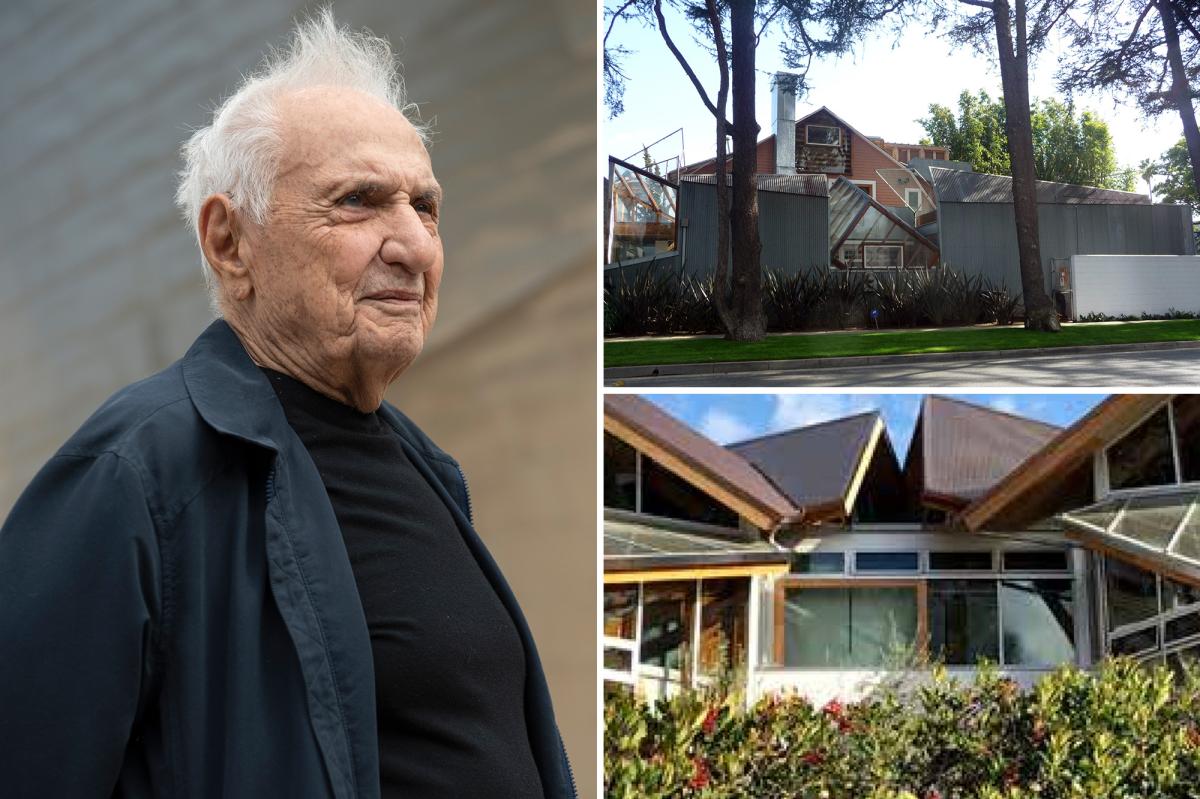
Before the Guggenheim Bilbao, Disney Hall, or 8 Spruce St. earned him worldwide fame, Gehry bought a modest 1920s Dutch Colonial bungalow in Santa Monica in 1977 for $160,000 (≈$846,000 today). He and his wife, Berta, called it a “sweet little house that everyone in the neighborhood liked.” With a modest $50,000 budget (≈$264,500 today) and a willingness to ruffle suburban sensibilities, Gehry transformed the pink façade into a deconstructivist landmark.
The project, now known simply as the Gehry Residence, became a laboratory for his signature use of raw industrial materials—plywood, corrugated metal, chain‑link fencing, and wood framing. Over years of construction, he wrapped the original structure in a shell of angular glass cubes and twisted metal, creating an indoor‑outdoor space that floods with light. The Los Angeles Conservancy described the result as “a sense of being perpetually under construction.”
Neighbors were less enthused; some were “really pissed off,” and one even filed a lawsuit. Yet the house attracted global attention, and architectural critic Paul Goldberger noted that it was the 1977 home that first put Gehry on the international map.
At 90, Gehry and his son, architect Samuel, built a second Santa Monica residence on Adelaide Drive, overlooking the canyon and Pacific Ocean. This time, the budget allowed for higher‑quality materials—Douglas fir replaced plywood, and finishes were more refined—while the design retained the signature angles, glass panels, and sculptural flair. Gehry described the new home as a “once‑in‑a‑lifetime” project in a 2019 Architectural Digest interview.
Both homes remain in the Gehry family’s possession, standing as testaments to the architect’s lifelong commitment to pushing boundaries, even in his most intimate spaces.