T
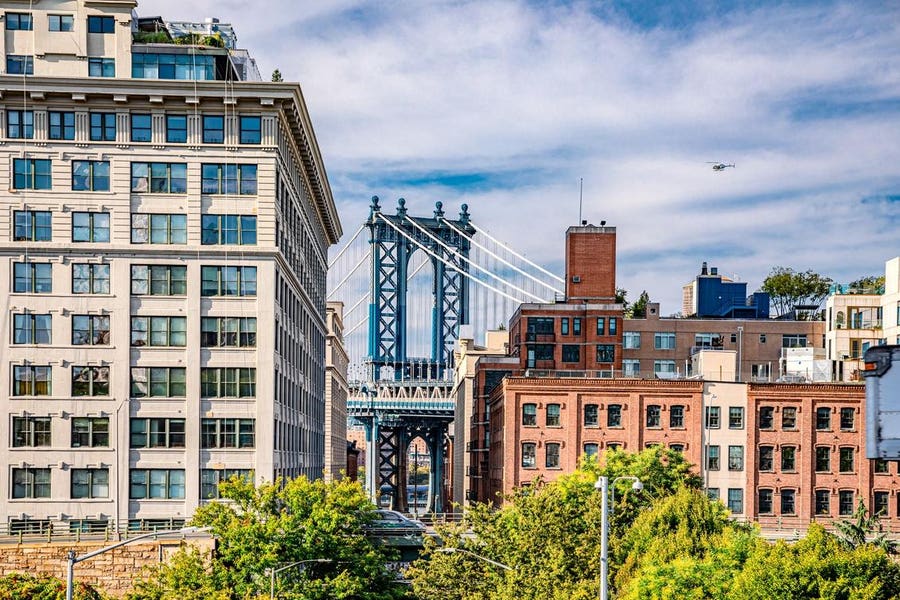
wo Trees began reshaping Brooklyn in the 1970s by buying a cluster of old warehouses in DUMBO. After the neighborhood was rezoned, the firm converted those buildings into more than 3 million square feet of mixed‑use space spread over 12 structures, creating a 24‑hour community that borders an 85‑acre riverfront park.
The firm’s strategy was replicated in Williamsburg, where it acquired the 19th‑century Domino Sugar Factory in 2012 and turned the site into The Refinery—a 460,000‑square‑foot campus of offices, retail and open space. Five additional contiguous sites are now finished or under construction, adding office, retail, rental and condominium units along the waterfront.
Today, Two Trees’ Brooklyn tenants are largely tech and creative firms; 40 % of new leases in Williamsburg are in AI or AI‑adjacent spaces. Their vertically integrated model keeps construction and property management in‑house, allowing the company to deliver high‑quality pre‑built spaces that command $40‑plus per square foot in DUMBO and $65‑$78 per square foot in Williamsburg. About 80 % of the decision makers who lease in Two Trees’ properties already live nearby, a shift from the earlier “sell Brooklyn” narrative to a reality where people want to live and work there.
Brooklyn’s fundamentals mirror strong housing demand. Median market‑rate rents rose 6.9 % year‑over‑year to $3,850 in October, while the Q3 2025 median sales price hit $1.05 million—a 7.7 % increase from the previous year. Investment activity followed suit: by the end of Q3 2025, Brooklyn saw $4.92 billion in transactions across 706 deals. Multifamily sales grew 22 % to $2.8 billion in the first nine months, and development site sales were up 10 % year‑over‑year, totaling $1.14 billion. The momentum is attributed to a political shift: a decade ago NIMBY sentiment dominated, but the last five to six years have seen a pro‑development stance, especially after the Gowanus rezoning and a broader recognition that building is the key to addressing the housing crisis.
Sergey Rybak, founder of Rybak Development, has benefited from this boom, completing or developing over 1,600 residential units citywide—more than 1,100 in South Brooklyn, Gowanus and Williamsburg. The firm’s vertical integration covers development, construction, management and curated retail amenities. The NYC Economic Development Corporation recently awarded Rybak a contract to build an 800,000‑square‑foot, all‑electric mixed‑use project in Coney Island, featuring 505 apartments (383 market‑rate, 122 affordable), retail, parking and community space. The project is expected to employ 300 workers daily for at least two years and will add more than 500 mixed‑income units on Coney Island West. Rybak emphasizes efficiency and believes policymakers should also encourage homeownership to help working families build wealth, a possibility that diminished after the 421a tax abatement expired.
SomeraRoad, led by Ian Ross, has bet heavily on Brooklyn Heights’ luxury condo market. In May 2025 the firm acquired the 116‑year‑old Hotel Bossert, a 14‑story Italian Renaissance Revival landmark that had sat vacant for over a decade. Ross plans to restore the building into branded luxury condos with world‑class amenities, reviving a structure once dubbed the “Waldorf‑Astoria of Brooklyn.” The hotel hosted the 1955 World Series celebration for the Brooklyn Dodgers and has a storied past, including ownership by Jehovah’s Witnesses in 1983 and subsequent stalled development plans. Ross remains bullish on New York City’s long‑term strength, citing unmatched talent, culture and demand.
While free‑market development thrives, rent‑stabilized housing faces a crisis. Since the Housing Stabilization and Tenant Protection Act of 2019, stabilized buildings trade at an average 50 % discount, with recent sales at 65 % off, and 14 % are in pre‑foreclosure or foreclosure. Roughly half of pre‑1974 stabilized buildings could face bankruptcy if rents remain frozen for four years under Mayor‑elect Mamdani’s proposal. Nearly 47 % of the city’s ~1 million stabilized apartments are in buildings that are 100 % or nearly 100 % stabilized, and about 5,000 buildings with >200,000 units are in severe distress, mainly in the Bronx and Northern Manhattan. Operating costs have surged: utilities up 31 %, maintenance 39 %, insurance 150 %. An NYU Furman Center study shows insurance costs per unit rose from $500 to $1,550 over the last decade. The average rent on stabilized units is $1,386, which barely covers taxes, water, sewer, insurance and sometimes mortgage, all of which have outpaced inflation. Two stabilized units in Bushwick sit empty because their rents of $577 and $612 cannot justify the necessary renovations, which would add $115 for water and $75 for repairs. In contrast, NYCHA public housing collects roughly $2,000 per unit (with tenants paying $500–$590) while paying no taxes, water, sewer, insurance or mortgage, yet still faces a $78 billion capital shortfall and cannot keep up with repairs.
Proposed solutions include creating a new tax class for buildings with 75 %+ stabilized units, overhauling the J‑51 tax incentive program to better support capital improvements, and reducing insurance costs. Housing Court efficiency must improve, as collections have dropped from 96 % to 90 % since COVID, and evictions now take 15–18 months, often two years, with legal fees exceeding 10 % when the city pays arrears to keep tenants.
Brooklyn’s story is one of two markets: a free‑market boom driven by policy support, private vision and tenant demand, and a regulated side unraveling under rising costs and insufficient rent. The contrast highlights the need for balanced solutions that sustain growth while preserving affordable housing.