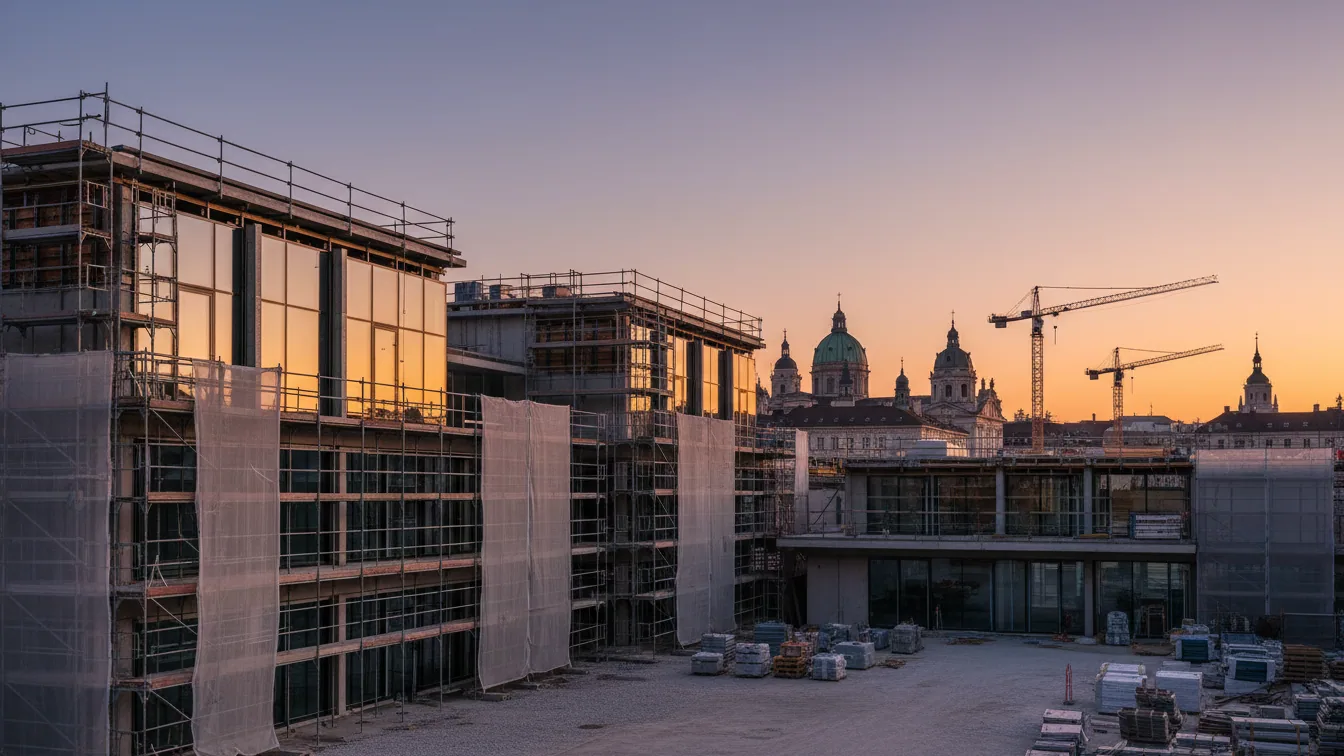
A new site for the production of satellite components is being established in Berlin. The German-American space company Planet Labs, known for its Earth observation satellites, is constructing a modern facility in Berlin-Charlottenburg. Across an area of approximately 5,000 square metres, laboratory, cleanroom, and office spaces for the assembly, integration, and testing of the latest generation of satellites will be realised. Consulting firm Drees & Sommer SE is overseeing the project management for this ambitious undertaking, which responds to the increasing relevance of satellite data for diverse applications ranging from navigation to climate research.
At the core of the new site are highly specialised cleanrooms of ISO classes 6 and 7. There, Planet Labs plans the manufacturing and testing of high-tech components for the new Pelican satellites. This technology enables the provision of high-resolution image data at short intervals, which are available almost in real-time. This allows for the rapid detection of changes on Earth, for example in the context of natural disasters, environmental changes, or infrastructure projects. The level of detail in the data contributes to identifying damage to bridges or energy facilities and supports the documentation of marine pollution as well as the analysis of climate change and disaster impacts.
Challenges in project management
Martin Polak, Managing Director of Planet Labs Germany, emphasised the importance of this expansion of the European headquarters into a “European Space Hub” for the company's European growth strategy. The hub is intended to bring together satellite manufacturing, engineering, mission operations, and business operations in one location to more rapidly convert innovations into operational capabilities and strengthen Europe's technological and industrial capacity in space. The realisation of this specialised production and laboratory environment requires close cooperation between international project teams from Germany and the USA, collaborating across multiple time zones.
Drees & Sommer is responsible for project management, cost, schedule, and quality management across all phases of the construction project. This also includes technical consulting services, the coordination of all planning and executing parties, and comprehensive interface management. Rojda Emre, Team Leader at Drees & Sommer, highlighted the importance of precise coordination among all stakeholders for demanding specialist properties with ambitious timelines. The company's expertise in laboratory, cleanroom, and high-tech production projects ensures that quality objectives, schedules, and technical requirements are reliably aligned. Particularly for the cleanrooms, the Drees & Sommer team coordinates the trades such that factors such as humidity, temperature, and particle concentration comply with the strict specifications for satellite manufacturing. This enables Planet Labs to assemble and test components such as sensors, electronics, and optical systems under controlled conditions.
Berlin as a centre of the space economy
Planet Labs, founded in 2010, has maintained its European headquarters in Berlin for over ten years and is expanding its team in the capital by up to 70 new employees to complement the existing approximately 150 staff members. A contract recently concluded with the German government for satellite reconnaissance, valued at 240 million EUR, underscores the relevance of the enterprise. Satellite data from Planet Labs, operator of the world's largest fleet of Earth observation satellites, finds diverse applications. Examples range from monitoring supply chains and agricultural areas to analysing refugee movements and civil security tasks. For instance, satellite data contributed to clarifying the fish kill in the Oder in August 2022 by detecting an increased chlorophyll concentration near Opole in the previous month. Martin Polak stressed that early detection of ecological changes enables rapid countermeasures, and satellites provide crucial information for this.
The Planet Labs project in Berlin aligns with a global trend. The 'New Space economy' is considered a crucial future market, whose global volume is expected to quadruple to 2,000 billion EUR by 2040. Investments in specialised locations such as the one in Berlin-Charlottenburg are deemed essential for Europe to secure its market share in the long term. Rojda Emre of Drees & Sommer added that the New Space industry requires individual building solutions such as cleanrooms and laboratories, which must meet the highest industry-specific standards. The design of these future-oriented spaces, from site analysis to commissioning, is actively shaped by her company's expertise.