M
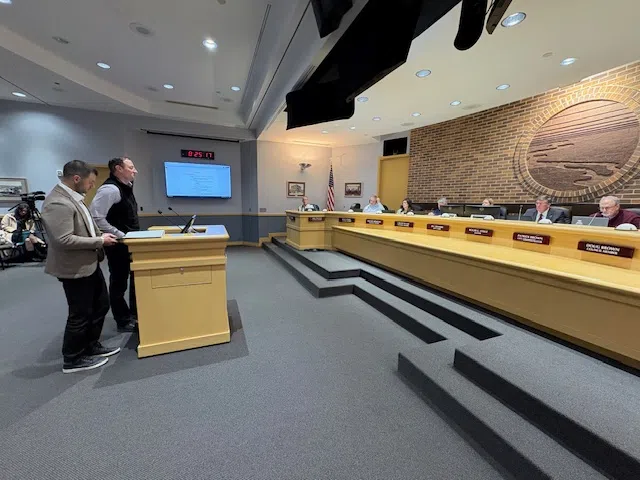
itch Hohlen, Woodsonia Real Estate’s development director, and Drew Snyder, the company’s president, presented a revised Veteran’s Village Good Life District plan at the December 9 City Council meeting. The council approved two resolutions that clear the way for Woodsonia to finish the project, which is funded by Good Life District money.
The first resolution, passed 8‑1, accepted supplemental application materials from Woodsonia that supplement the original 550‑page Good Life District application and 60‑page executive summary submitted in the November 12 packet. Councilman Doug Lanfear opposed the motion; Mike Paulick was absent.
The second resolution, also 8‑1 (Mendoza opposed), authorized city staff to negotiate a development contract with Woodsonia, contingent on the amended application. President Ryan O’Neill added an amendment requiring staff to incorporate the council’s feedback, commitments, and concessions from the December 9 meeting into the contract and to protect the city’s interests in line with the Good Life District Economic Development Program (Grand Island City Code Chapter 38, Article II). O’Neill explained that the amendment ensures any terms inconsistent with the city’s goals are excluded, even if they appear in written materials.
During the 3.25‑hour session, residents and council members voiced concerns about the Aquatics Center, residential scope, and the absence of dedicated pickleball courts in the indoor Sports Complex. The proposed development sits north of the Burlington Railroad tracks, south of Airport Road/US 281, and between Broadwell Avenue and Webb Road, excluding the former Nebraska Veterans Home site. The estimated cost is $600 million.
Key components of the plan include an indoor Sports Complex, an expanded Aquatics Center, additional sports fields, an enlarged Eagle Scout Lake and trails, an amphitheater, a 10‑acre elementary school site, commercial space for a hotel, event venue, restaurant, mixed‑use space, apartments, and single‑family homes. Chad Nabity’s November 12 memo highlighted the need for a three‑lane pool, but Woodsonia’s revised proposal now calls for a 10‑lane, 25‑yard competitive pool, a diving well, seating for 400, a zero‑entry warm‑water therapy pool, and a Jacuzzi. The pool’s lanes can be oriented north‑south or east‑west. The new Aquatics Center will cover roughly 30,000 sq ft and cost an estimated $25 million, $10 million above the original estimate. The YMCA’s aging pool, opened in 1979, will be replaced, and the YMCA is interested in building a new facility adjacent to the complex.
The YMCA’s new director, Chad Knight, welcomed the plan, and YMCA spokesman Pat O’Neill noted the potential for a new YMCA at Veteran’s Village. Regional Planning Director Chad Nabity said the first bond would issue in 2026, with a second in 2027.
Woodsonia’s staff emphasized the project’s goal of attracting more people to Grand Island. Karen Johnson, president of the Grand Island Pickleball Club, raised concerns that the Sports Complex would lack dedicated pickleball courts. Snyder responded that the complex would include lines for 28 non‑dedicated courts, but Johnson argued that dedicated courts are essential, citing a Columbus sports center with eight dedicated courts. She noted that the current non‑dedicated indoor courts at the Fieldhouse, YMCA, and Tennis Center are unavailable at night and on weekends. The club has 221 members paying $25 annually, and Johnson estimates 1,500–2,000 Grand Island residents play pickleball, a sport that continues to grow among all ages.
O’Neill defended the decision, explaining that expanding shared‑court access is a cost‑effective way to meet demand while allowing future expansion if needed. He also mentioned that the plan provides more indoor access than the Fieldhouse and could be studied for future projects.
Former Mayor Jay Vavricek supported Woodsonia’s application, noting that a tree planted now may not be available to sit under later. Developer Scott Rief, who runs RIZER, praised Woodsonia’s Conestoga Marketplace redevelopment but expressed concerns about an “unfair advantage” in receiving Good Life District funds and TIF financing. He highlighted that Woodsonia would acquire the Veteran’s Village property for $1, receive 23 % of Good Life District funding and 10 % through TIF, and that the project includes 250 multi‑family units and 20 single‑family units in Phase 1, with similar numbers in Phase 2 (2030‑2035) and $40 million in mixed‑use development in Phase 3 (2036‑2055). Rief noted a softening market with many vacant apartments and listed other local developments.
Councilman Mitch Nickerson, a real estate agent, warned that the project is aggressive and referenced a housing study indicating a need for 300 new units per year. He also pointed out newly built houses that have remained vacant. Councilman Jack Sheard noted that Woodsonia receives significant incentives for housing development. Gerald Poels raised concerns about the amount of land Woodsonia would “own for free” and called for a feasibility study to assess impacts on schools, road maintenance, and snow removal. He also highlighted the lack of a four‑year college in Grand Island and the need for a new high school, suggesting an indoor pool there would be more logical.
Snyder described the Sports Complex as a “tournament‑driven” facility and said Woodsonia would select its manager. Hohlen emphasized workforce housing demand, citing a 1,000‑sq‑ft home selling for $275,000 versus $400,000 elsewhere. Nickerson urged Woodsonia to consider the city’s aggressive development plan. Snyder outlined financing: Phase 1A would use net bond proceeds and cash totaling $77.6 million; Phase 1B would add $17.6 million; total TIF over 15 years would be $52.1 million. The city may levy a 200‑basis‑point occupation tax on sales within the project to fund future maintenance.
Woodsonia proposed clawback conditions: if Phase 1 infrastructure, the Sports Complex, lake expansion, amphitheater, 250 multi‑family units, 20 single‑family units, a hotel, restaurant, and one commercial development are not completed within five years, the company must return undeveloped property to the city for $1. If the company fails to deliver at least one commercial development, 250 multi‑family units, and 20 single‑family units by 2035, it forfeits remaining Good Life District funds for Phases 2 and 3, returns undeveloped land, and cancels unused TIF areas. The proposal limits construction to no more than 100 multi‑family units and 20 single‑family homes annually.
Regional Planning Director Nabity urged swift progress to demonstrate to the governor and legislature that the project is moving forward and to avoid future legislative action on Good Life District funds. Woodsonia aims to have next‑stage documents drafted by January 23, 2026, and bond‑related drafts by February 22, 2026.
Roger Bullington, Chief Construction, praised Woodsonia’s experience with Conestoga Marketplace, calling the redevelopment of a “zombie mall” a valuable case study. He noted that early opening of Target generated revenue and that Woodsonia’s plan for Veteran’s Village is the “proper way to do it.” He stressed that too many parties could derail the project and that time is critical.
Councilman Doug Brown called the project a “golden opportunity.” Councilman Jason Conley expressed support. Mayor Roger Steele highlighted Woodsonia’s success in turning Conestoga Mall into Conestoga Marketplace, including a Target store, and praised the Good Life District application. He noted the project’s residential, commercial, and recreational components and expressed satisfaction with the city’s “good luck” in securing the plan.
The project timeline, outlined in Woodsonia’s executive summary presented at the November 12 meeting, follows a series of approvals: the city passed a resolution in December 2023 supporting Woodsonia’s Good Life District application; the initial application was approved in June 2024; voters approved the project in August 2024; the state amended the Good Life District project in June 2025; and Woodsonia submitted a revised application in August 2025. The public received detailed information only at the November 12 meeting, a point raised by former Mayor Jay Vavricek regarding media coverage.