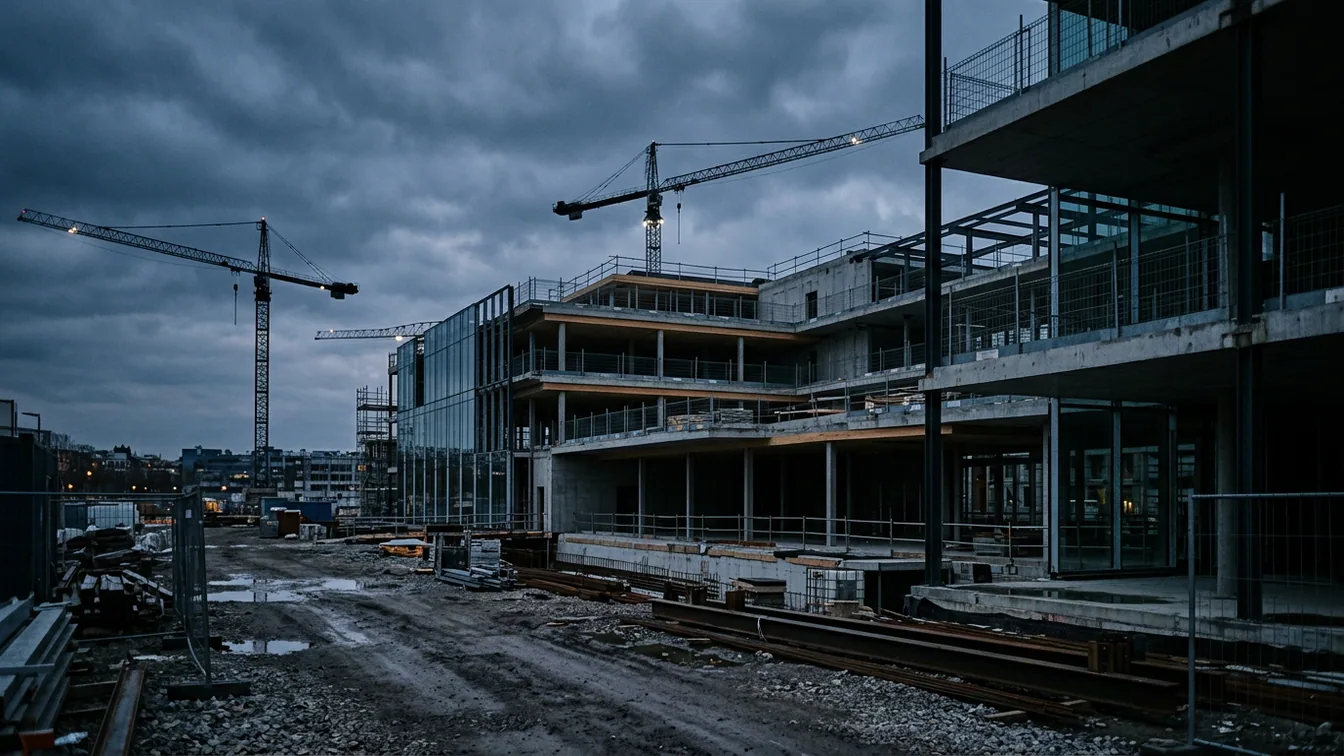
German building construction is not expected to see substantial recovery even in 2026. Despite continued high demand, particularly in the residential segment, high construction costs, increased interest rates, and global uncertainties are impairing demand. A strategy and transaction consultancy forecasts a slightly reduced decline of 0.2 per cent for the current year, following a 3.6 per cent decrease in construction activity in 2024 and a further 1.9 per cent in 2025. Actual recovery with real growth of 0.8 per cent is only anticipated from 2027 onwards, with a potential increase to 1.2 per cent in 2028.
In contrast, the infrastructure segment of the construction industry is proving to be a key growth driver. Supported by significant public investment, this area is recording real growth of approximately 4 per cent. Volkmar Schott, Partner at EY-Parthenon, emphasised in this context that infrastructure programmes and a high need for modernisation in sectors such as transport, water, and energy are likely to secure this steady market growth in the coming years. Although the annual market volume of infrastructure construction accounts for only about a quarter of the building construction volume in monetary terms, the increasing activities in this area could compensate for the declines in building construction in 2026.
Challenges in Residential and Non-Residential Building Construction
Building construction is primarily suffering from the slump in new residential construction. Both the private owner-occupied housing sector and commercial multi-storey residential construction recorded a decline of 6.9 per cent each in 2025. Björn Reineke, also a Partner at EY-Parthenon, explained that while the demand for housing remains consistently high, current construction prices, interest rates, and uncertainties have led to a backlog in demand. He suggested that a reduction in regulatory requirements and more consistent cost management could revitalise demand, though a return to pre-crisis levels is unlikely in the medium term.
New non-residential construction is also experiencing a decline, albeit more moderately. Commercial new construction decreased by 1 per cent last year, and public building construction by 0.6 per cent. Many companies are shifting investments abroad or into state-stimulated sectors such as infrastructure construction, driven by a weak economy and higher location risks such as labour costs and energy prices. Modernisation measures, which usually have a stabilising effect, also showed a decline in 2025, particularly in energy-efficient renovations, which is attributable to uncertain funding conditions and high costs.
Cautious Recovery and Political Measures
For building construction, no rapid recovery but a gradual stabilisation is expected in the period from 2026 to 2028. Efficient cost structures and moderate pricing are crucial factors for future market growth to avoid dampening demand through excessive passing on of cost increases to customers. A positive signal is the robust development of new business with construction loans in 2024 and 2025, which shows that banks continue to finance solid construction projects.
Political measures could also contribute to market relief. Reforms of the German Building Code, bureaucracy reduction, and accelerated approval procedures aim to reduce existing impediments. Furthermore, an additional EUR 3.5 billion annually has been invested in social housing since 2025, which is intended to particularly support subsidised rental housing construction. In 2025, the German government also established a special fund for infrastructure and climate neutrality amounting to approximately EUR 500 billion. A large portion of these funds, 55 per cent, is earmarked for infrastructure construction, while 18 per cent will benefit the building construction segment.