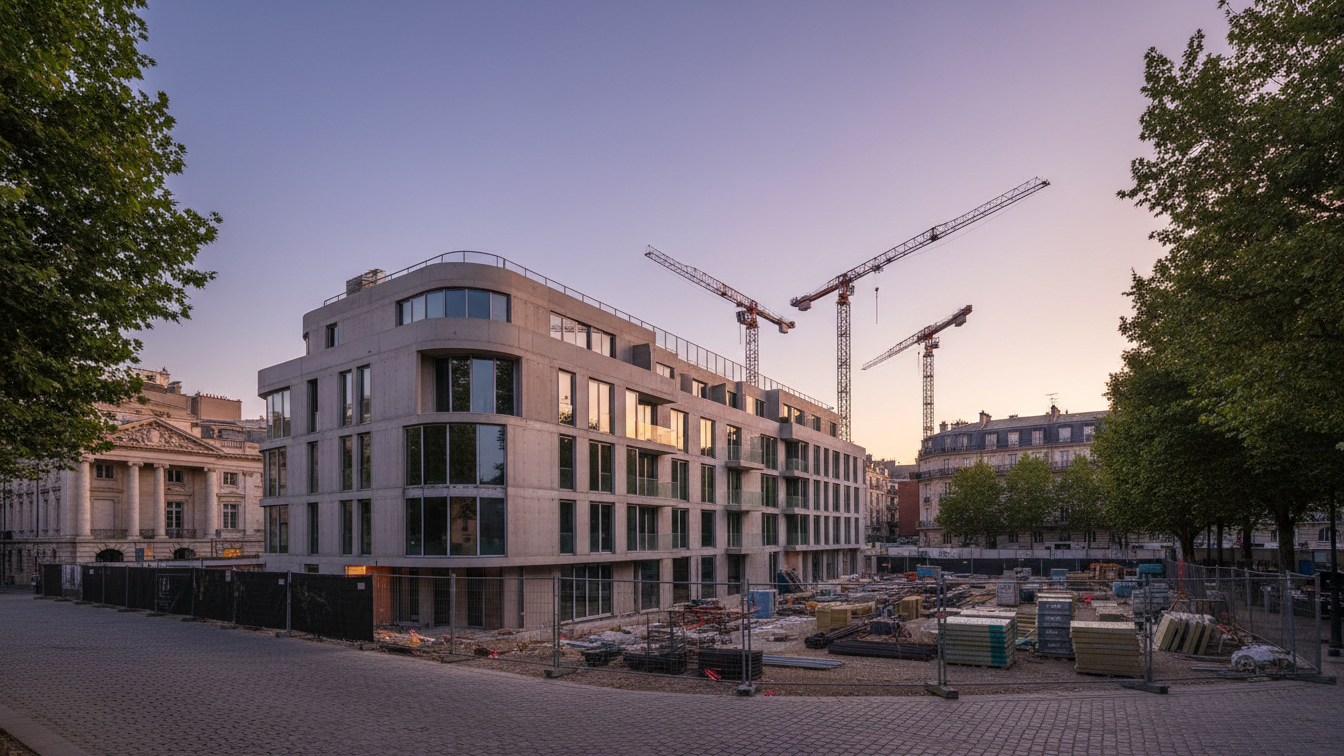
US housing starts fell in August, registering one of the weakest monthly performances since the pandemic. Total housing starts declined by 2.6 per cent, while multifamily housing starts plummeted by almost 22 per cent. This is according to data from First American Financial Corporation. Simultaneously, housing completions dropped by almost 12 per cent, representing the slowest pace since late 2018, according to Bloomberg.
In parallel, commercial real estate debt funds held a record 56 billion US dollars in available capital (dry powder) at the end of August, with approximately 16 billion US dollars raised in the first half of 2026. This was reported by CRE Daily, citing Green Street data. Private debt funds, it was noted, have increased their holdings of commercial real estate loans by around 104 billion US dollars since 2019. In short: commercial real estate lenders have more capital than ever before to finance projects.
While fewer projects meet the criteria for such financing – as the housing data indicates – this is an excellent time for projects from developers with established reputations and deep resources. Eric Cohen, Managing Director and Co-Head of Debt Origination at Affinius Capital, commented: “The market is awash with capital from banks, private lenders, and other players, all keen to be active in the construction sector, including banks that were previously sitting on the sidelines.” He added that if a project is viable, a competitive market for that business typically emerges, and sufficient capital is available to support construction.
Challenges with Equity and Loosening Guidelines
Jeffrey Rosenfeld, Founder and Principal of North River Partners, pointed out that the biggest challenges in construction finance currently lie on the equity side. Projects with successful equity raising therefore become even more desirable than usual for lenders. Rosenfeld explained: “Housing starts and permits are undeniably down – there is less construction underway. Since fewer projects can raise enough equity to actually proceed with construction, there is an expanded pool of lenders pursuing a smaller pool of projects.” PitchBook noted in early September that overall private capital raising was “on track for its fifth consecutive annual decline,” with Private Debt being the exception and “the only strategy with an increase in fundraising year-on-year.”
Given this development, underwriting standards for suitable housing projects have been relaxed – to a certain extent. Rosenfeld remarked: “If you are a well-capitalised borrower who either has discretionary capital or can find a project that pencils out in such a way that it can raise money, you’ll have a lot of options when seeking a construction loan.”
Competition and Market Imbalance
In an April 2026 Federal Reserve Bank survey on changes in commercial real estate lending policies, banks reported that they had “eased or left essentially unchanged” most lending terms for commercial real estate. The most frequently cited changes were “higher maximum loan amounts, narrower loan rate spreads over banks’ cost of funds, and longer interest-only payment periods.” The most common reason given was “more aggressive competition from other banks or nonbank lenders.” However, given the reduction in housing starts and the increased challenges in raising equity, fewer projects can meet the standards for being well-capitalised.
Rosenfeld clarified: “There is a smaller subset of developers who are even able to get to the point where they can close on a construction loan.” Brent Gilfedder, Partner in the Real Estate & Funds practice at King & Spalding, agreed that while much capital is waiting to be deployed, the challenge of bringing deals to a close means fewer projects qualify for financing. “It’s very difficult to make a development project pencil out, given the overall real estate environment,” said Gilfedder. He described a “peculiar situation” where projects either find equity but no construction loan financing, or construction loan financing but no equity.
Gilfedder attributed this partly to the current interest rate environment and rising construction costs. Given the higher construction costs, many deals, even with available market capital, do not make sense, as many people would ask: “Can I buy something cheaper than replacement cost?” In the multifamily sector, the answer is often yes, which reduces the willingness for development projects. Therefore, lenders, eager to deploy their ample dry powder, are looking for stronger projects, while also having to consider the significance of current economic indicators.
Jay Neveloff, Partner and Chairman for US Real Estate at the law firm HSF Kramer, reported that given the Federal Reserve’s recent interest rate hike, some of the lenders he spoke with are approaching new projects with a sense of uncertainty. Neveloff noted: “There are lenders getting nervous.” He spoke of a withdrawal of capital sources, and some contacts were concerned about further rising interest rates. Nevertheless, Rosenfeld believes that for those who have capital and are prepared to deploy it in the market, the current lending environment is a “tale of two markets,” where lenders are rolling out the red carpet for the shrinking pool of suitable borrowers.