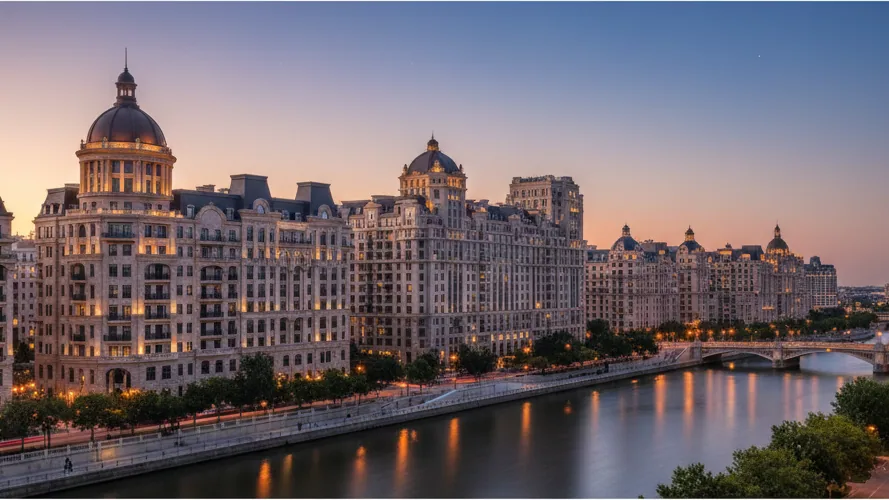
The Munich office leasing market showed significantly increased activity in the second quarter of 2026. According to analyses by Cushman & Wakefield, take-up between April and June 2026 reached approximately 190,000 sqm. This represents a 55 per cent increase compared to the same period last year (Q2 2025: 122,700 sqm). Cumulatively for the first half of 2026, office space take-up amounts to 329,200 sqm, corresponding to a 26 per cent increase compared to the first half of the previous year. The quarterly volume exceeded the 10-year average by approximately 31 per cent.
This positive development was not primarily driven by an isolated large transaction, but by consistent market activity across diverse size categories. Matthias Hofmann, Head of Regional Branch Management Germany and Head of Office Agency Munich at Cushman & Wakefield, highlighted that both the second quarter and the entire first half of 2026 revealed significant momentum. The half-year result surpasses the 5-year average by 15 per cent and is now only 5.3 per cent below the 10-year average. This positions Munich, alongside Berlin, as one of the top performers in the German office market.
Drivers of market development and industry focus
The positive market development was significantly influenced by a large number of small and medium-sized deals, as well as a major owner-occupier transaction. The largest single transaction in the second quarter was the expansion of Apple's site at Seidlstraße 15–19, encompassing more than 29,000 sqm. Other notable deals over 5,000 sqm included Siemens at the Science Center (approx. 6,750 sqm), Alphalignis at Südlicht (approx. 6,450 sqm), and Analog Devices at the Highlight Towers (approx. 5,380 sqm). In total, 195 deals were recorded in the second quarter, which means an almost unchanged number of deals compared to the same period last year (H1 2026: 295 deals; H1 2025: 291 deals), but signals an increased average deal size due to higher space take-up.
The majority of space take-up in the second quarter, approximately 150,000 sqm out of around 190,000 sqm, was attributable to lettings, while owner-occupiers accounted for approximately 40,000 sqm, mainly through the Apple transaction. In terms of sectors, information and communication technology as well as industrial companies dominated market activity, together generating more than 50 per cent of total space take-up. Mr Hofmann noted that the consistently high number of deals demonstrates that demand is not solely dependent on large enquiries, and that companies with a clear strategy are prepared to implement extensive decisions.
Rent development and vacancy rate
The prime rent continued its upward trend, reaching EUR 57.00/sqm in the second quarter, an increase of 1.8 per cent compared to the previous quarter and 3.6 per cent year-on-year. The average rent also rose to EUR 27.55/sqm, up 1.7 per cent quarter-on-quarter and 3.0 per cent year-on-year. Demand for modern, high-quality and well-connected office spaces, particularly in central locations such as Altstadt and Maxvorstadt, supports this rent level. The market is segmented, with high-quality spaces experiencing strong demand, while older stock needing modernisation comes under pressure. The willingness to pay for products that support modern working models and meet ESG requirements remains high.
The office vacancy in Munich increased to approximately 2.01 million sqm by the end of the second quarter of 2026. This led to a vacancy rate of 9.2 per cent, an increase of 40 basis points compared to the previous quarter and one percentage point compared to the same quarter last year. This increase results from ongoing market selection, where changed working models, a more critical assessment of space requirements, and increasing demands for sustainability and flexibility mean that not all available spaces are immediately absorbed. Properties that only partially meet current user requirements are particularly affected by this.