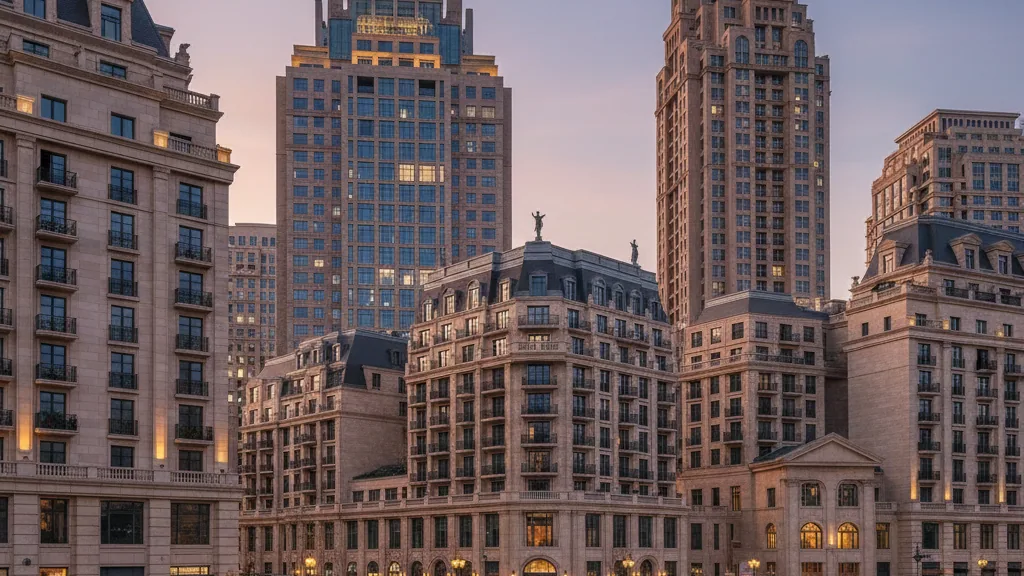
Ahead of the most important shopping season of the year, the New York retail property market is approaching a milestone where two contrasting dynamics collide. Whilst prime locations are characterised by intense demand from well-heeled brands, outlying corridors continue to suffer from structural vacancy. Peter Braus, president and co-owner of Lee & Associates NYC, describes market activity as a balancing act between two extremes. On the one hand, finding suitable space in established neighbourhoods is becoming increasingly difficult, as rents reach levels not seen for a long time.
This fierce competition is particularly evident in neighbourhoods such as SoHo and along Madison Avenue. For an Italian fashion brand seeking a location in SoHo and for which a draft lease was already in place, a competing offer from a rival recently came in. Yet only a few underground stops away, the picture is completely different. Along Broadway between City Hall and Tribeca, deserted shopfronts stretch across entire street blocks.
Divergence between prime corridors and secondary locations
According to data from the New York City Comptroller's vacancy dashboard, around 16,047 of the city's nearly 142,000 retail premises were vacant in September. The city-wide vacancy rate rose to 11.32 per cent in the third quarter, remaining above the pre-pandemic figure of 10.5 per cent. In five neighbourhoods, including the Financial District, Tribeca, Ocean Hill, East New York and Old Astoria-Hallets Point, roughly one in five retail units remains empty. For Manhattan, the authority currently puts the rate at 13.12 per cent. Jessica Walker, president of the Manhattan Chamber of Commerce, points to caution surrounding hiring and dismissals, as well as ongoing uncertainty among smaller business owners.
In contrast, the luxury segment is booming. Charlie Koniver of Odyssey Retail Advisors reports a clear surplus of interested parties in prime retail pitches. Even shops that stood vacant for years, such as on Madison Avenue, are now seeing multiple competing bidders.
- —According to CBRE, the average prime asking rent in Manhattan climbed by 5 per cent in the third quarter to $ 707 per square foot.
- —In SoHo, available retail space fell to an all-time low of just two active listings.
- —Across Manhattan's 16 prime corridors, the supply of ground-floor space fell by 12 per cent year-on-year.
- —Total rolling leasing volume fell by 22 per cent in the fourth quarter, driven by a shortage of space as well as high interest rates and construction costs.
Entrenched long-term vacancy in problem areas
Despite the shortage of space in prime locations, Manhattan recorded a leasing volume of 1.05 million square feet in the most recent quarter, led by a 28,000-square-foot deal signed by Five Iron Golf at 32 Old Slip and 14,000 square feet for Century Cricket at 25 West 39th Street. In Brooklyn, a new Burlington store at the Navy Yard pushed take-up to 248,000 square feet.
Nonetheless, a considerable share of vacancy remains chronic. As municipal surveys show, 60 to 80 per cent of unoccupied units in many affected neighbourhoods have been vacant for at least nine months. Local clusters are found on Nostrand Avenue in Crown Heights, around Church Street and Chambers Street in Tribeca, and along a 51-block stretch of Broadway on the Upper West Side.