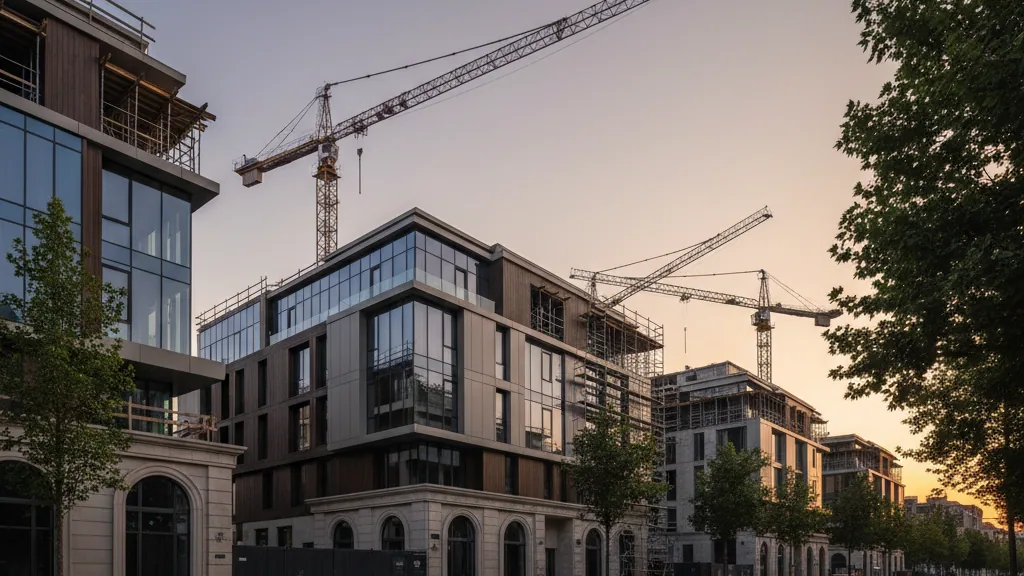
The development of building permits for dwellings in Germany continues to show a positive trend. In August 2026, a total of 20,600 residential units were approved, representing an increase of 6.8 per cent compared to the same month last year. Cumulatively, for the period from January to August 2026, the number of approved dwellings totals 169,400. This marks an increase of 12.1 per cent compared to the same period last year.
The dynamic in the multi-family housing segment is particularly noteworthy. Here, a total of 90,600 dwellings were approved from January to August 2026. This corresponds to an increase of 14.5 per cent compared to the corresponding period of the previous year.
Leveraging the Potential of Building Type E
Aygül Özkan, Chief Executive Officer of the German Property Federation (ZIA), commented on the development: she stated that the increase in building permit figures primarily demonstrates the existing will to build. At the same time, she emphasised a significant discrepancy between the desire to build and actual completion. A sustainable upswing in construction activity could therefore only be achieved if construction costs could be significantly reduced.
To achieve these cost reductions, Building Type E, in its legally sound design, is urgently required. Özkan pointed out that the key points paper for Building Type E has been available for almost a year now, and it is time to swiftly unlock its potential instead of leaving it unused.
Reliable Framework Conditions for Investments
In addition to Building Type E, reliable framework conditions are indispensable for investments in residential construction. The ZIA calls for a long-term predictable funding environment, the creation of better tax incentives through a practical special depreciation allowance (Sonder-AfA), and stable financing conditions.
- —Long-term predictable funding environment
- —Practical special depreciation allowance
- —Stable financing conditions
The German government's Invest in Germany Summit on 19 and 20 October is regarded as an important signal in this context. The ZIA welcomes the government's proactive efforts to attract investors, including for residential construction. The provision of affordable housing relies on private capital, while discussions about nationalisation or interventions in property rights create uncertainty and hinder urgently needed investments.