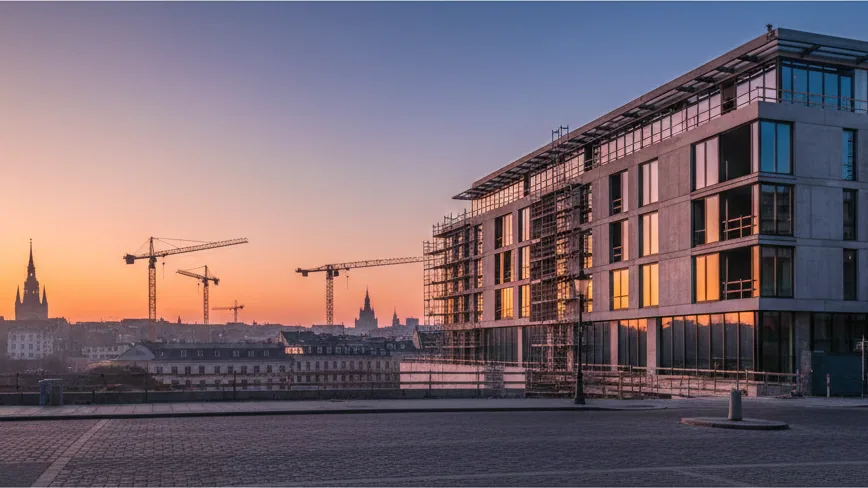
In the face of an ongoing annual shortfall of over 100,000 homes in Germany, existing commercial building stock is increasingly coming into focus. Berlin Hyp, together with the analysis firm bulwiengesa, has published the brief study "Conversion 2.0: New potential for more housing". The investigation builds on an earlier survey that identified a theoretical potential of around 150,000 apartments in larger office properties built before the year 2000 on the peripheries of Germany's seven A-cities.
Economic viability and mixed-use approaches in office properties
Office markets are undergoing a structural shift towards modern, flexible spaces in central, well-connected locations. Above all, high construction costs and lengthy planning permission processes have so far impeded pure conversions of office buildings for residential use. The concept of mixed use is increasingly regarded as a key factor in achieving viable economics: combining residential space with other commercial uses, along with the deployment of technological innovations, is intended to reduce costs. At the political level, initiatives such as Building Type E ('Gebäudetyp E') and acceleration measures aim to dismantle construction-related hurdles.
In addition, shopping centres are coming to the fore as another asset class. In five of the seven A-cities, almost 16 per cent of lettable space in shopping centres is currently vacant. Bulwiengesa estimates the resulting theoretical conversion potential at around 3,000 apartments with an average area of 70 square metres each. Existing public transport links and established infrastructure support such projects, although substantial planning law and structural-architectural challenges remain to be overcome. That implementation can succeed is demonstrated, among other things, by the partial conversion of space in the Berlin property "Boulevard Berlin" into serviced apartments.
Industry experts on the feasibility of transformation projects
During the digital Berlin Hyp market briefing, industry representatives discussed the practical prerequisites for conversions. From a banking perspective, Patrick Walcher, Chief Markets Officer at Berlin Hyp, emphasised that while conversions are not yet standard practice, they have long progressed beyond isolated cases. Crucial factors for financing, alongside location and building condition, include a viable risk profile, robust cash flow and a sustainable overall concept.
- —Alexander Fieback, Head of Research at bulwiengesa, stressed the need for an integrated location assessment to align falling commercial demand with specific local housing requirements.
- —Franziska Bouchard, specialist lawyer for construction and architectural law at forvis Mazars, pointed out that lifecycle adaptations in existing buildings must be factored in going forward, requiring legal frameworks, technical solutions and tax incentives to mesh together.
- —The authors of the study highlight that transformation projects in existing buildings can make a substantial contribution to conserving resources while simultaneously creating housing.
Given that a substantial proportion of the buildings that will be in use in 2050 are already standing today, the retrofittable adaptability of commercial property is becoming fundamentally important. The targeted conversion of structural vacancy thus constitutes a challenging yet forward-looking component of urban development.