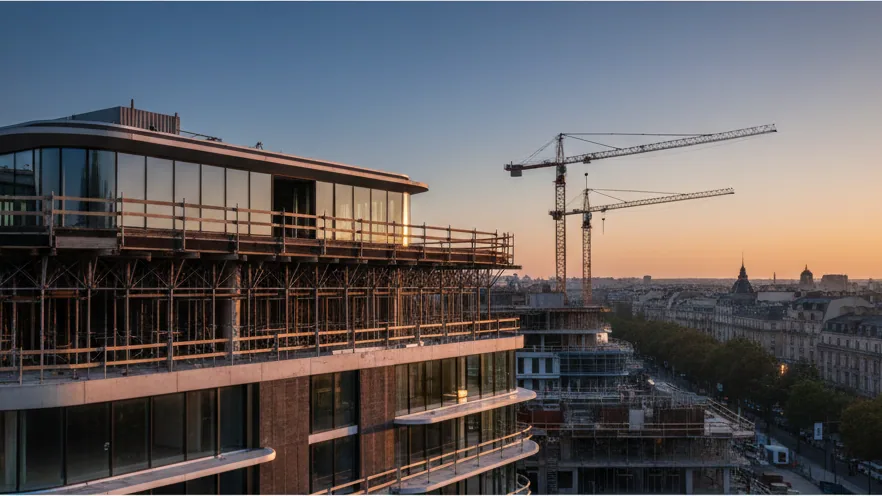
The Federal Statistical Office registered the issuance of over 21,000 more building permits in May 2026 than in May 2025. This corresponds to an increase of 24.7 per cent compared to the same month of the previous year. In the multi-family housing segment, the number of permits accumulated to 56,100 dwellings in the period from January to May 2026, representing an increase of 18.9 per cent or 8,900 dwellings compared to the same period last year.
Aygül Özkan, Chief Executive Officer of the ZIA, emphasised that visible progress existed only on paper, but the realisation of housing took place on construction sites. She noted the market's readiness and subsequently called on politicians to create the appropriate framework conditions through reliable financing, the introduction of Building Type E, and a clear commitment to protecting private property.
Necessary Course Corrections for Residential Construction
To sustainably revitalise residential construction and mobilise private capital, precise political decisions are required in four key areas. These measures are intended to promote investment and remove existing obstacles.
- —Clarity on Building Type E: The pending draft law on Building Type E is considered essential for implementing construction projects more efficiently and cost-effectively through simplified and standardised requirements. Swift and comprehensive implementation of all available simplifications for the planning and construction of new build projects is imperative.
- —Clarity on Financing: High financing costs and inadequate framework conditions hinder investment decisions. The ZIA proposes the use of equity-replacing instruments such as state guarantees, sureties, and subsidies to generate liquidity. Furthermore, a significant reduction or suspension of property transfer tax for first-time buyers and private landlords is demanded.
- —Clear Regulations on Socialisation Efforts: The discussion about the socialisation of housing companies undermines investor confidence in legal certainty and endangers essential investments. The federal government's clear stance on this issue is welcomed, and a rapid implementation of the coalition committee's resolution into concrete legislation is urged.
- —Elimination of Cost Drivers: Statutory regulations, such as the planned "Law on Strengthening Natural Infrastructure and Further Developing Nature Conservation Intervention Regulations," must be critically examined. Expected cost increases, for example, a proposed 20 per cent surcharge on compensatory payments, would impose additional burdens in an environment of already high construction, land, and financing costs, negatively impacting the economic viability of residential construction projects.
Ms Özkan concluded by stressing that the creation of affordable housing must not be accompanied by a continuous increase in construction costs. At the same time, the protection of property and the facilitation of investments are indispensable for the realisation of new housing.