Corporate Real Estate Management (CREM) is evolving into a strategic partner within companies. This key insight was formulated at the CoreNet Global (CNG) EMEA Summit, which took place for the first time in Munich from 8 to 10 September. Under the leading theme "Beyond the Horizon: From Complexity to Clarity", international experts discussed how real estate strategies must adapt to geopolitical uncertainties, technological change and new demands on working environments.
Lina Scherer, President of the Central Europe Chapter of CNG, highlighted that corporate real estate decisions today extend far beyond mere space, location and cost considerations. She emphasised that real estate decisions must make a measurable contribution to overarching corporate objectives. This includes aspects such as corporate resilience, talent attraction capability, corporate culture and the overall performance of an organisation. Ms Scherer also noted that the Summit in Munich clearly demonstrated the profound change in the profession's self-conception.
Resilience and Flexible Strategies in Focus
The importance of resilience is coming increasingly to the fore in the context of real estate decisions, influenced by geopolitical developments, energy supply, climatic challenges and demographic shifts. Companies are required to make their real estate portfolios more resilient to proactively respond to different developments. This necessitates an increased application of scenario planning and flexible strategies. For CRE professionals, this means a shift from reactive action to the early identification of potential developments, the simulation of various scenarios and a portfolio alignment that sustainably secures the company's ability to act.
Ms Scherer pointed out that the experiences of recent years have shown that a return to long-term stable conditions is not to be expected. She underlined that the crucial competence in the future will be to make sound decisions even under uncertain conditions. This requires reliable data, the development of various scenarios and real estate strategies that can adapt to changing circumstances.
Transformation of the Workplace and Influence of Technology
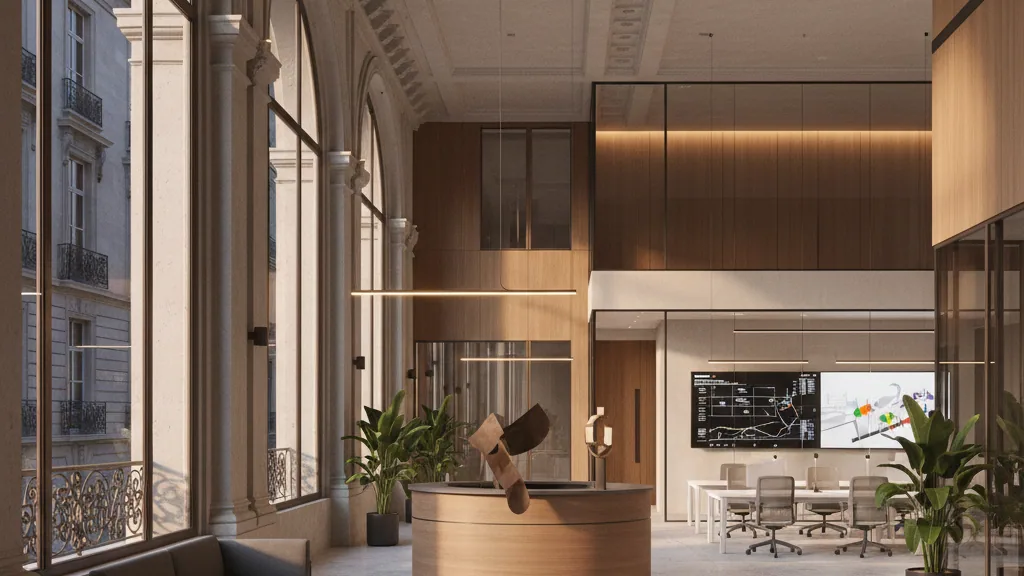
Another significant development is the changing perspective on the workplace. Instead of a pure analysis of space requirements, the question increasingly posed is what contribution a space should make to the company. Working environments are increasingly designed with aspects such as productivity, collaboration, corporate culture, employee retention and user experience in mind. Given hybrid working models, people remain at the centre of consideration. Personal encounters, the feeling of belonging and a shared identity are gaining in relevance. The task of Corporate Real Estate is therefore to create places that offer a recognisable added value compared to purely digital work.
Ms Scherer explained that the discussion about the future of the office has long ceased to be a purely quantitative question of space. Rather, the focus is on what contribution a place can make to collaboration, identification and performance. While technology plays an increasingly important role, it does not replace human interaction. Accordingly, the growing importance of Artificial Intelligence (AI) was extensively discussed in Munich. AI already influences areas such as workplace strategies, portfolio analyses, forecasts and decision-making processes. At the same time, technological progress increases the demands on the quality and interpretation of data, as data alone does not generate added value. Crucial is their contextualisation within the company and the derivation of concrete courses of action. This also implies a redefinition of the requirements for CRE teams, who, in addition to real estate expertise, increasingly need technological capabilities and a deep understanding of their own company's business models and strategic goals.
According to CoreNet Global, this development leads to closer collaboration between Corporate Real Estate and other business units. Real estate decisions today equally touch upon issues of corporate strategy, personnel acquisition, sustainability, digitalisation, energy supply and business continuity. Lina Scherer summarised that Corporate Real Estate is increasingly involved in the decision-making of strategic corporate issues. The task is to understand global developments and derive precise decisions for locations, portfolios and working environments from them. Through the synergistic consideration of technology, data and human needs, Corporate Real Estate can become a significant strategic value driver.
- —The CoreNet Global EMEA Summit 2026 took place in Munich from 8 to 10 September.
- —The focus was on strategy and portfolio management, workplace, sustainability, technology and leadership.
- —The next EMEA Summit will be held in London from 20 to 22 September 2027.