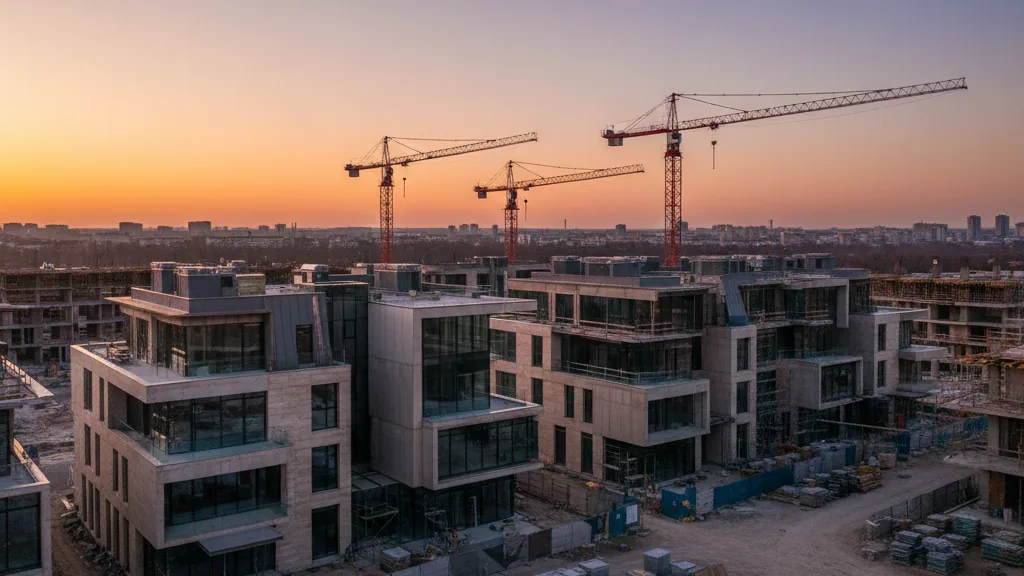
Few Proptech companies have successfully scaled their technology to profit from the data centre construction boom. OpenSpace, a visual intelligence platform from San Francisco, has served this sector with more than 1,000 projects in the USA, Europe, the Middle East, Canada, Australia and Singapore. The company specialises in documenting and analysing the progress of over 100,000 construction projects worldwide.
Jeevan Kalanithi, CEO and co-founder of OpenSpace, recently explained his company's unique perspective on one of artificial intelligence's (AI) biggest challenges: the physical construction of the necessary infrastructure. He outlined why the AI race has now reached a physical phase, what major construction challenges arise with hyperscale and AI-focused projects, and why real-time transparency is becoming crucial for risk management and schedule reliability. Owners, contractors and developers are learning how AI infrastructure is being scaled globally.
Efficiency and Risk Minimisation in Data Centre Construction
OpenSpace makes construction significantly simpler and less risky. Given the current data centre construction boom, the technology is specifically designed to minimise risks in these projects. A recent advancement in their offerings is OpenSpace Track, a progress tracking system that uses data from various sources such as 360-degree cameras and mobile phones. This visual way of working is more efficient than previous methods and allows for critical insights, for example, whether a project is on schedule.
Given the demand and high costs for data centres, the costs of delays or errors are extremely high. Kalanithi reported a case where a delay in a data centre led to contractual penalties of US$500 million, a sum he described as 'absolutely staggering'. New ways of working that reduce the risk of such an incident to under one percent make a significant difference.
AI in Physical Construction
Kalanithi clarified that the current wave of AI, driven by foundation model companies, is transforming the economy, and data centres are being built to meet this demand. Today's AI systems are primarily trained on digital information such as text, tables and code. However, the real economy, operating in physical reality, generates relevant data on-site. When speaking of 'physical AI', this refers to AI systems capable of understanding physical reality. This includes robotics and the management of the real economy in construction, where systems must understand not only words but also physical processes. OpenSpace technology is designed to capture the real conditions on data centre construction sites and enable more informed decisions.
Generally, there were many opportunities for the use of technology within the mega-cycle of data centre construction. Data centres are bringing industry-wide problems that have always existed into extreme focus – particularly the discrepancy between available labour and enormous demand. It is essential to increase workforce productivity, as a rapid replenishment of ranks is not currently expected. In the construction of these complex and costly data centres, traditional construction methods and their margins can no longer be afforded. Therefore, stakeholders are forced to find new ways of project delivery, as there is no other choice.