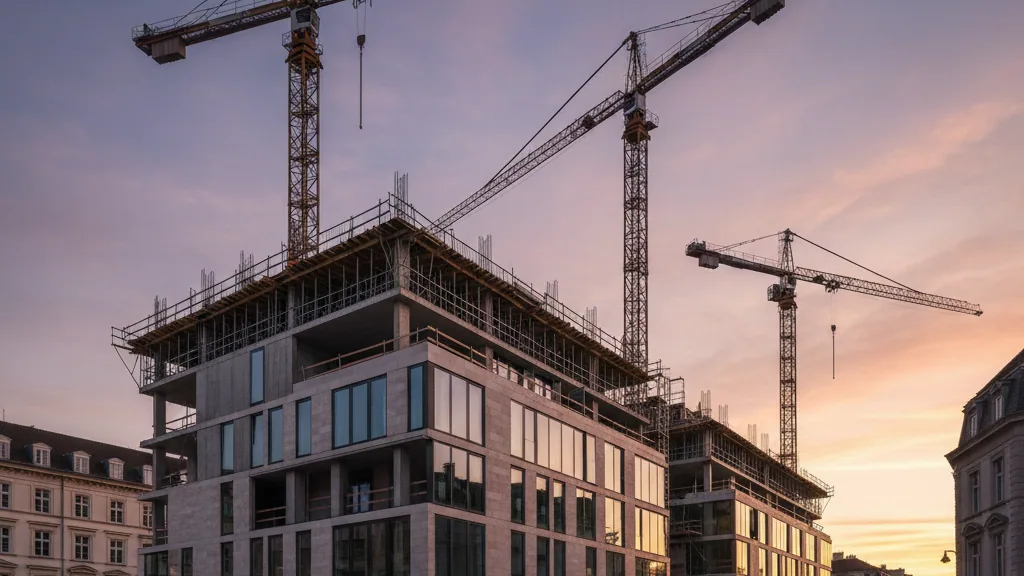
The trend in rental prices in Germany's eight largest cities shows a noticeable slowdown in the first half of 2026. Average asking rents increased by three percent. This contrasts with the same period last year, when growth of 6.8 percent was recorded. In parallel, the market for owner-occupied apartments is showing positive development, with price growth of 2.9 percent year-on-year.
In Berlin, Düsseldorf, Frankfurt, Hamburg, Cologne, Leipzig, Munich, and Stuttgart, the average asking rent for existing and new-build apartments was EUR 17.98 per square metre. Leipzig proved to be the city with the most affordable housing at EUR 11.19 per square metre, while in Munich, rents were more than double at EUR 25.41 per square metre.
Regional Differences and New-Build Segment
Outside the metropolises, differentiated trends were observed. In independent cities, rental growth of 3.4 percent was almost at the previous year's level (3.3 percent). Rural districts even saw an acceleration to 4.8 percent compared to the previous year (3.7 percent). The analysis evaluated approximately 32,000 rental and 27,000 purchase offers, considering both new-builds and existing buildings.
Rental growth in the new-build segment has slowed to almost 0.5 percent, as already observed in the second half of 2025. Average new-build rents in the eight metropolises were EUR 21.39 per square metre. Dr. Sören Gröbel, Director of Living Research JLL Germany, attributes this development to a shrinking supply of new-build apartments and a growing proportion of price-controlled units. This means that individual projects disproportionately influence rent trends, and the measured changes reflect individual property data rather than general market developments.
A quality-adjusted analysis reveals strong rent increases in Leipzig (six percent) and Hamburg (4.8 percent). Berlin, however, recorded a rent decrease of one percent after such an adjustment. The absolute front-runners in new-build apartment rents were Munich with EUR 26.48 per square metre, followed by Hamburg (EUR 23.75) and Stuttgart (EUR 23.00). Leipzig remained the most affordable market at EUR 15.00 per square metre.
For existing apartments, the momentum was higher than in the new-build segment, averaging 3.3 percent, but significantly flattened compared to the previous year (6.6 percent). The average new contract rent for existing apartments was EUR 17.54 per square metre. Hamburg showed the strongest development with an increase of 6.2 percent, although a slowdown was also evident here. Berlin was the only metropolis with a decrease in new contract rents for existing apartments of 4.2 percent.
Price Increases and Long-Term Burden
It is noteworthy that affordable apartments became disproportionately more expensive. Rents in the lowest price segment increased by 5.5 percent, while prime rents in the average of the eight metropolises rose by 2.3 percent. Gröbel explains that willingness to pay at the upper end of the market is reaching its limits, and affordability is becoming the decisive factor for rental growth. This manifests itself in higher-priced apartments increasing less in price than more affordable properties.
Over the past five years, rental prices in the eight cities have risen by an average of five percent annually, representing a significant financial burden for many households. Berlin leads this long-term trend with an average annual increase of 8.4 percent, followed by Leipzig with eight percent. Stuttgart showed the lowest growth at 1.9 percent annually. The persistently tight situation in the rental housing markets, caused by high demand and insufficient supply, prompted legislators to further tighten rental laws. Completion figures for 2025 have further declined, with Stuttgart recording the sharpest decrease. Leipzig and Cologne, however, showed positive developments in building permits, the effects of which will only become apparent in completed units with a delay.